How to Connect AI Agents to Real Enterprise Systems Safely
What changes when an AI agent moves from demo mode to real systems: secure APIs, orchestration layers, approvals, observability, and production boundaries that actually hold.
In this article
- The hard part starts after the demo works
- Treat the model like a decision engine, not a root user
- The orchestration layer is where the real safety model lives
- Secure APIs are the real interface to AI agents
- Separate read actions, workflow actions, and write actions
- Failure handling has to be designed, not discovered
- Observability is not optional for agent systems
- A practical rollout strategy
- Final thought
The hard part starts after the demo works
It is relatively easy to make an AI agent look impressive in a controlled demo. Give it a few tools, connect it to a clean dataset, and let it answer questions or trigger a simple action. The experience can feel magical. The problem is that enterprise systems are not demo environments. They are messy, stateful, permissioned, audited, and full of edge cases that matter.
I have seen this most clearly in regulated environments where the question is not just whether an agent can do something, but whether it should do it, whether the action can be traced, and whether the underlying system remains consistent when something fails halfway through. Once AI touches real workflows, safety stops being a feature and becomes the architecture.
Treat the model like a decision engine, not a root user
One of the fastest ways to create risk is to let the model talk too directly to your operational systems. The model may be good at deciding what the user seems to want, but it should not be the thing that owns entitlements, workflow invariants, or transaction safety. Those concerns belong in the application layer.
In practice, I prefer to treat the model as a reasoning component that proposes the next step while the platform decides what is allowed. That means the model can select tools, shape context, or draft requests, but it should never become a hidden super-admin sitting behind a prompt.
- Expose narrow tool contracts instead of broad database or service access.
- Require every tool call to pass through the same policy checks your product APIs already respect.
- Keep permission logic, business rules, and compliance controls outside the model.
The orchestration layer is where the real safety model lives
The best production setups I have worked on all place a hard orchestration layer between the model and enterprise services. That layer owns intent-to-tool mapping, argument validation, context enrichment, policy checks, retries, and audit events. Without it, teams end up hiding system behavior inside prompts, which makes the whole workflow brittle.
This pattern matters even more when one user action fans out across multiple services. A single request may require identity resolution, entitlement checks, account lookup, workflow validation, downstream API execution, and a user-safe response. The orchestration layer is what makes those steps observable, deterministic, and debuggable.
Architecture diagram
AI agent integration with enterprise safety boundaries
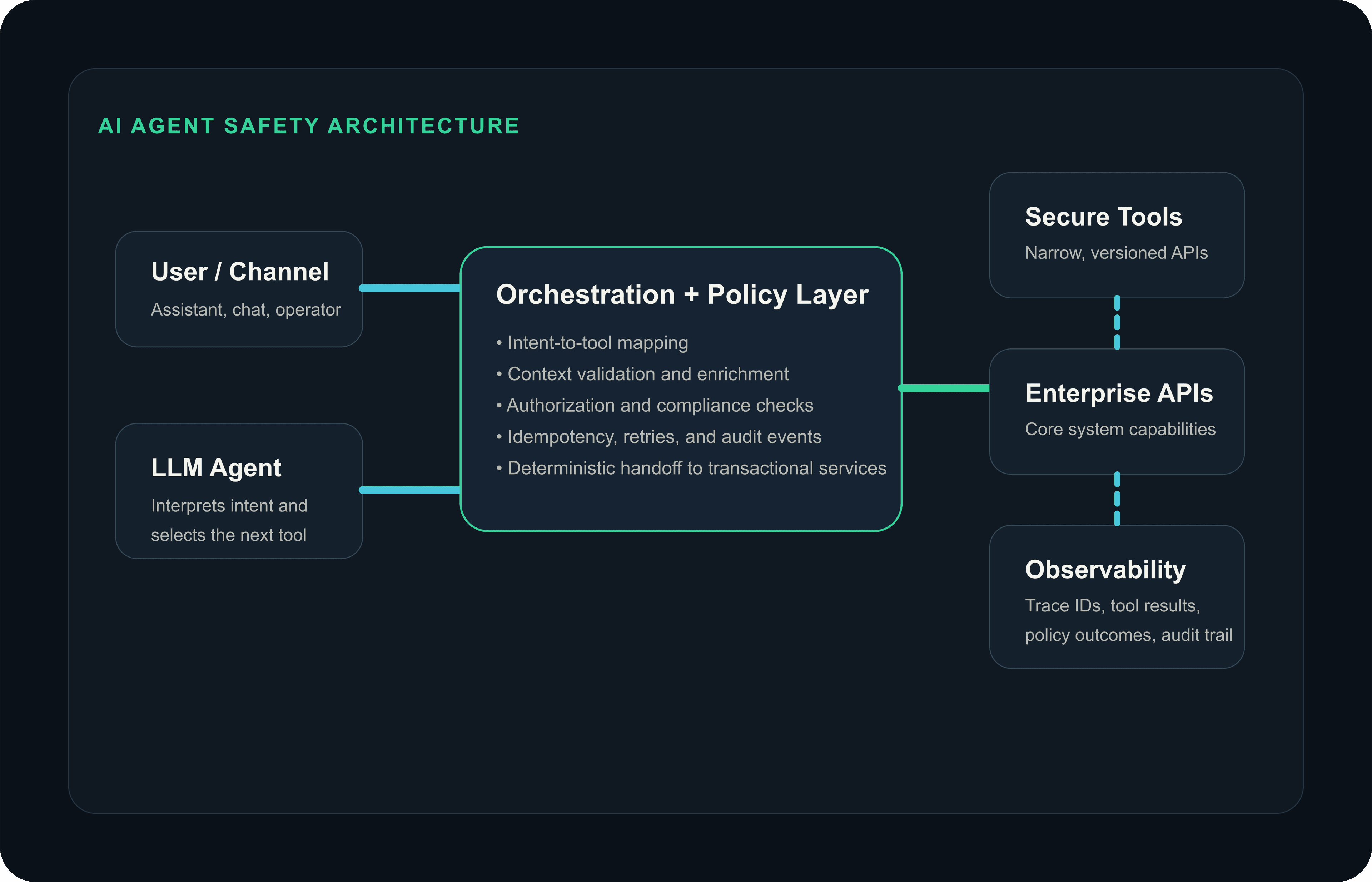
A tool invocation envelope should carry enough structure to validate, trace, and replay safely.
{
  "requestId": "req_78b4",
  "actor": {
    "userId": "u_1421",
    "channel": "assistant",
    "sessionId": "s_90fd"
  },
  "tool": "account.lookup",
  "arguments": {
    "customerId": "c_4812",
    "includeBalances": false
  },
  "policyContext": {
    "role": "service-agent",
    "region": "AE"
  }
}
Secure APIs are the real interface to AI agents
If an enterprise wants AI agents to do meaningful work, it eventually needs AI-facing APIs. But those APIs should not be a special shortcut. They should be first-class platform interfaces with strong authorization, request validation, audit trails, and clear ownership.
This is where a lot of teams underestimate the work. The real challenge is not exposing an endpoint. It is exposing a capability safely enough that the surrounding platform still behaves correctly when requests arrive at high volume, in unusual sequences, or with partial context. Safety is not just about blocking bad calls. It is also about making legitimate calls repeatable, traceable, and reversible where possible.
- Use scoped service identities rather than generic credentials.
- Log the actor, requested action, policy result, and downstream system outcome for each call.
- Design idempotent operations whenever the workflow can be retried.
- Limit returned data to what the task actually needs.
The AI-facing API should look like a normal production API, not a privileged backdoor for the model.
POST /v1/tools/payment-initiate
Authorization: Bearer <service-token>
Idempotency-Key: pay_20260508_001
X-Trace-Id: trace_4f1a

{
  "workflowId": "wf_723",
  "requestedBy": "assistant-orchestrator",
  "customerId": "c_4812",
  "amount": 2500,
  "currency": "AED"
}
Separate read actions, workflow actions, and write actions
Not every tool deserves the same trust model. Read-only retrieval is a different risk profile from workflow progression, and both are very different from state-changing operations. If everything is modeled as just another tool call, the safety model gets blurry fast.
I like to separate tools into clear classes. Retrieval tools answer questions. Workflow tools advance a process with guardrails. Write tools create or modify state and often require stronger approval or tighter context checks. Once those classes exist, the platform can treat them differently instead of pretending all tool calls are equal.
Failure handling has to be designed, not discovered
In production, the most important thing to know is what happens when the agent gets it wrong, a downstream service times out, or one step succeeds while the next one fails. You need deterministic fallback behavior before you need more autonomy. A system that fails safely is more valuable than one that looks smart until the first edge case.
That usually means explicit timeout budgets, retries with backoff, compensation logic where appropriate, and workflow states that can be resumed outside the prompt. It also means being honest in the response layer: if the workflow is pending approval, partially completed, or rolled back, the user should see that clearly.
- Use circuit breakers around sensitive downstream services.
- Store workflow state outside the prompt so execution can resume safely.
- Return actionable failure states, not vague model apologies.
The orchestrator should move workflow state explicitly instead of relying on the model to remember what happened.
type WorkflowState =
  | "received"
  | "policy_checked"
  | "awaiting_approval"
  | "tool_executed"
  | "completed"
  | "failed";

await workflowStore.update(workflowId, {
  state: "awaiting_approval",
  lastTool: "payment-initiate",
  retryable: false,
  traceId,
});
Observability is not optional for agent systems
If you cannot see how the model reasoned, which tools it chose, what arguments it sent, which policies were evaluated, and where latency accumulated, you are not running a production AI system. You are gambling with one. Good observability turns agent workflows from mysterious to debuggable.
I want to be able to trace a request from user input to orchestration logic to downstream service calls and final response. That level of visibility is what lets teams improve prompts, tighten policies, spot regressions, and respond calmly when something unusual happens.
A practical rollout strategy
The safest path is progressive exposure. Start with read-only flows. Then add workflow suggestions. Then allow constrained actions in low-risk domains. By the time the agent can trigger important operations, the surrounding controls should already be well understood by the team.
This also gives product, security, and platform teams time to align. In my experience, enterprise AI goes better when it is framed as a systems problem shared across disciplines, not as a model experiment that the rest of the organization is expected to absorb later.
Final thought
Connecting AI agents to enterprise systems safely is less about finding the perfect model and more about building the right boundaries. Models change quickly. Sound orchestration, secure APIs, observability, and careful workflow design age much better.
If the platform makes good decisions easy, unsafe decisions hard, and failures visible, the agent becomes something the business can trust. That is the real milestone, not the demo.